



 Facebook
 Reddit
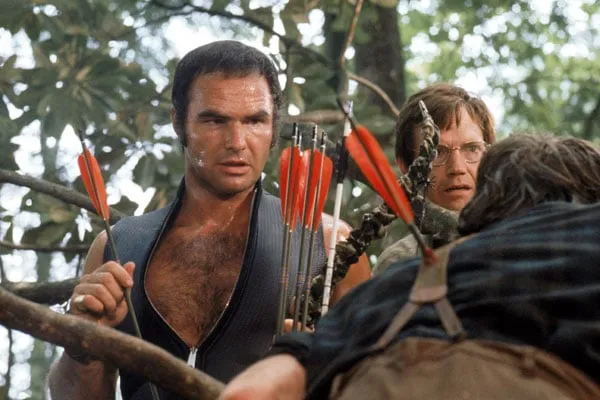
Four white, middle class men decide to go for a river-rafting weekend down the Cahulawassee River before it is dammed by the power company. At one extreme is survivalist type Lewis, played by Burt Reynolds; see this film and have your perceptions of him as a easy-going good old boy type incapable of serious drama utterly shattered. At the other is the sensitive Drew, played by Ronny Cox, who mocks Lewis' assertions that the power company is “raping” the landscape as those of “an extremist”. Between these two are Ed and Bobby, no less memorably essayed by John Voight and Ned Beatty respectively.
When Ed and Bobby have a run-in with some of the local mountain men – men as alien as the Viet-Cong, in the midst of America itself – and one is killed in self-defence, the fault lines within the group and, by extension, the wider society are rudely exposed.
 Lewis, predictably, favours doing nothing, with the mountain man having got what was coming to him for sexually assaulting Bobby, while Drew, equally predictably, believes the representatives of the law should be informed and will understand. Not wanting their shame and humiliation to become in any way public, Ed and Bobby side with Lewis.
As far as the mountain men are concerned it's all moot anyway as by killing one of theirs the four men have just escalated the conflict into a life-or-death fight to the finish...
Inverting the gender dynamics of the traditional rape-revenge film, John Boorman's classic adaptation of James Dickey's novel, Deliverance, works brilliantly as both film entertainment and in exposing and critiquing the condition of the white middle-class American male in the wake of Vietnam and all that.
Never-mind the over-hyped The Exorcist and its comfortable good-triumphs-over-evil reassurances, this is the most shocking and disturbing mainstream American horror film of the 1970s in both the questions it asks – what would you do in the men's situation? – and, even more importantly, its refusal to provide easy answers.
Yes, the mountain men are perhaps demonised as unknowable other. Yes, the film arguably exploits the more common real-life rape scenario of male perpetrator and female victim. Nonetheless, for a Hollywood film, in particular, it remains a remarkably serious, thoughtful and thought-provoking work; indeed, the very fact these criticisms emerge rather than being conveniently closed off seems more a testament to its accomplishments than anything else.
And I didn't even mention Duelling Banjos...
Reviewed on: 09 Jan 2007

If you like this, try:
Review preview for Southern Comfort
The oppressive atmosphere of the swamp and the tension between the frustrated alpha males are so thick right up to the final frame you could cut the air with one of their knives, while the trauma of the experience lingers long after the credits roll.
Review preview for Straw Dogs
The film has been unjustly vilified. It has a powerful impact, not only because of the violence, but because of its visual and emotional clarity.